
In partnership with

Happy Sunday, friends ☀️
I put my fly swatter down just long enough to write this intro today. The flies in our area seem to have arrived alongside every new shoot and bud, and living out in the Portuguese countryside reminds us every year that nature likes to keep things balanced. In winter it’s mould… in spring and summer, it’s flies auditioning for ownership of the kitchen 😅
Last week, I promised you our article on buying property off-plan in Portugal, and I need to apologize for the scheduling mix-up. That article from Fresh Properties is still coming next week, and if you’ve been considering buying in Portugal, especially in a new development, I genuinely think you’re going to find huge value in it.
But this week, we’re wrapping up our three-part NHR 2.0 / IFICI series with what might actually be the most important question of all:
Is Portugal still worth it without NHR?
Over the past few years, Portugal became known as the place for expats looking for sunshine, safety, lifestyle, and tax advantages. But now that the old NHR regime is gone, many people are wondering whether the dream still makes sense financially, or whether the conversation around moving to Portugal has fundamentally changed.
In today’s final article, Fresh Portugal takes a step back from the technical jargon and looks at the bigger picture: what made Portugal attractive in the first place, what opportunities still exist under IFICI, and why the country may still hold enormous appeal for the right kind of person.
And if you missed the first two articles in this series, you can catch up here and here before diving into today’s edition.
Let’s get into it, shall we? 👇
TODAY’S SPONSOR 🫶
Smart starts here.

You don't have to read everything — just the right thing. 1440's daily newsletter distills the day's biggest stories from 100+ sources into one quick, 5-minute read. It's the fastest way to stay sharp, sound informed, and actually understand what's happening in the world. Join 4.5 million readers who start their day the smart way.
📷 Pic of the week

The Tower of the Crystal Palace Garden or torre do jardim do palácio de cristal sits on a cliff that has guided ships into the Douro since at least 1542, when a stone tower first marked the river entrance. In the 1860s, Porto built its own Palácio de Cristal here, a grand iron and glass exhibition hall inspired by London’s Crystal Palace and surrounded by romantic gardens designed by German landscape architect Émile David. The palace was demolished in 1951 to make way for today’s Pavilhão Rosa Mota, but public outrage was so strong that the gardens kept the Crystal Palace name. The torreão remains as one of the surviving viewpoints from David’s original design, overlooking the Douro among camellias, ginkgos, and wandering peacocks.
⏸ Quote Of The Week
"All great changes are preceded by chaos."

⚖ Legal Matters

Gif by thefastsaga on Giphy
For years, NHR helped make Portugal one of the most attractive destinations in Europe for expats.
But now that it’s gone… what changes?
In the final article of our NHR 2.0 series, Fresh Portugal unpacks whether Portugal still makes sense without NHR, what the new IFICI framework actually offers, and why the conversation around relocating here is evolving.
Let’s hand it over to the experts 👇
⚖
Is Portugal Still Worth It Without NHR?
Since the end of Portugal’s Non-Habitual Resident (NHR) regime, a recurring question has emerged in conversations around international relocation. Interestingly, the question is rarely framed in technical or purely fiscal terms. Instead, it often reflects a broader concern: if the NHR regime is no longer available, is Portugal still worth it?
Behind this question lies a deeper reflection about what has historically driven relocation decisions. For many internationally mobile individuals and families, Portugal became associated with tax efficiency. Yet the more fundamental issue is whether Portugal was ever primarily a tax strategy, or whether it was always a lifestyle and long-term positioning decision supported by favourable tax rules.
The Role NHR Played
For more than a decade, the framework offered expats a simple and attractive tax environment. The possibility of benefiting from a 20% flat tax rate on Portuguese-source employment income coming from high value-added activities, combined with exemptions applicable to some categories of foreign-source income such as rental income and dividends, created a compelling incentive for individuals considering relocation within Europe.
For many, the regime helped simplify the financial justification for moving to Portugal, particularly when compared with the tax burdens typically associated with other European jurisdictions. In that sense, NHR served as an important catalyst for the country’s growing popularity among international residents. Its removal inevitably changes that dynamic. However, it does not eliminate the broader reasons why Portugal became attractive in the first place.
Portugal’s Appeal Beyond Tax
While tax considerations played a significant role during the NHR years, relocation decisions are rarely based solely on fiscal advantages. Portugal’s appeal has always rested on a broader combination of economic, social and lifestyle factors that continue to remain relevant today.
Among these are the country’s political and social stability within the European Union, access to the European market, and a predictable legal and institutional framework.
Portugal also offers great climate and food, a strong healthcare system, an increasingly international education environment, and a high level of personal safety compared with many global urban centres.
At the same time, a well-established international community and real estate prices that remain comparatively competitive relative to many Western European capitals reinforce Portugal’s position as an appealing place to live and work.
For many families in particular, Portugal’s proximity to the rest of Europe, both geographically and culturally, represents a significant advantage, allowing easy access to major European cities while maintaining a more relaxed lifestyle environment and quality of life.
For these reasons, the lifestyle argument in favour of Portugal remains strong even in the absence of the NHR regime.
A More Structured Tax Landscape
The end of the NHR regime does not mean that tax planning opportunities in Portugal have disappeared. What has changed is the nature of the planning process itself.
Under the previous framework, the regime often functioned as a broad and relatively straightforward incentive that applied across a wide range of profiles. In the current environment, relocation decisions tend to require a more detailed and tailored analysis of each individual’s circumstances.
Portugal has also introduced new mechanisms designed to attract talent, innovation and investment. One of the most notable examples is the Tax Incentive for Scientific Research and Innovation (IFICI), which provides a favourable tax framework for individuals engaged in certain qualified activities linked to innovation, technology and internationally oriented businesses. The main selling point is a full exemption from Personal Income Tax on all income coming from outside of Portugal, except pension income and income from tax havens.
Unlike the former NHR regime, however, IFICI is not designed as a universal relocation incentive. Instead, it targets specific types of economic activity intended to strengthen Portugal’s innovation ecosystem and international competitiveness.
In practical terms, there are different ways in which individuals may fall within the scope of the regime.
One possibility arises where an individual incorporates and actively develops a qualifying company in Portugal, often in connection with a technological initiative or business idea that they intend to pursue. In these situations, eligibility depends on the company meeting the criteria established under Portuguese law and on the activity being carried out with genuine economic substance.
Another route may involve investment in a qualifying Portuguese company, where the individual supports the development of an eligible business project while operational activity is carried out by a local team or management structure. In this context, “investment” should not be understood purely in financial terms. Depending on the circumstances, it may involve the contribution of capital, expertise, time, strategic input, or a combination of these elements, particularly where the individual plays a role in supporting the development or internationalisation of the project.
In both scenarios, the company involved must generally fall within categories recognised by the legislation, such as certified startups, export-oriented companies, or companies carrying out activities considered economically relevant under Portuguese law. As with most targeted incentive regimes, eligibility ultimately depends on the existence of genuine economic activity and sufficient operational substance in Portugal.
This approach reflects a broader policy shift. Rather than offering a universal tax incentive to all new residents, Portugal is increasingly focusing on attracting individuals who contribute directly or indirectly to innovation, investment and economic development.
Conclusion
Portugal without the NHR regime is not the same proposition it was five years ago, when a simple tax incentivesplayed a central role in shaping the country’s international reputation.
That does not necessarily make the country a less compelling destination. Portugal continues to offer political stability, access to the European Union, a strong quality of life and an increasingly international environment that appeals to globally mobile individuals and families, as well as a new tax regime targeting those who wish to start their own businesses or invest in Portugal while achieving a full exemption on almost all of their foreign source income.
What has changed is the nature of the tax conversation. It has become more technical, more selective and more closely linked to genuine economic activity. In many respects, this evolution may ultimately lead to more intentional relocation decisions.
⚖
With thanks to our collaborators at FRESH Portugal, for their valuable insights and contributions to this article.
The legal team at Fresh Portugal is composed of experienced professionals with expertise in tax, immigration, real estate, estate planning, and corporate law. They advise individuals and businesses on relocation, investment, compliance, and tax planning. With extensive experience working with international clients, the team delivers clear, practical, and forward-thinking solutions to help expats thrive in Portugal.
Email: [email protected]
📺 This Week’s Worth-Your-Time Watch
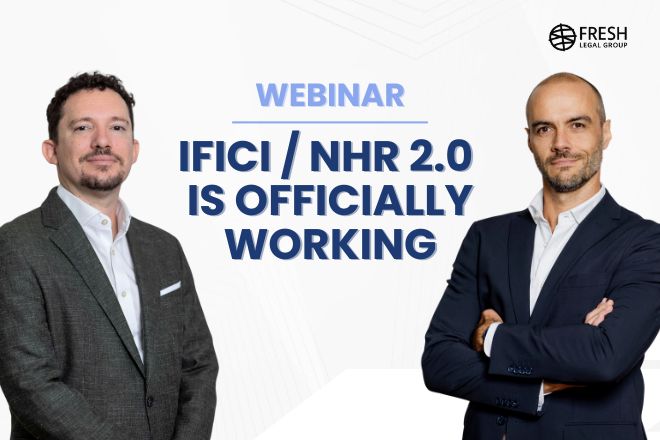
If today’s article leaves you wanting to understand how IFICI / NHR 2.0 works in the real world, not just in theory, this upcoming webinar from Fresh Portugal looks incredibly valuable.
Now that the first round of approvals has officially come through, there are finally real cases to learn from, real structures being tested, and real insight into what’s actually working (and what isn’t). The webinar is especially relevant for founders, investors, entrepreneurs, remote professionals, and anyone exploring whether they could realistically qualify under the new framework.
They’ll be covering who is getting approved, common mistakes people are still making, and why Portugal is reshaping its approach around innovation, startups, and internationally connected talent.
🗓 Thursday, 21 May 2026
⏰ 16:00 Portugal time
If this topic is relevant to your future plans in Portugal, this is probably one worth attending.
🗣 Lost in Lingo - by Mia Esmeriz
In Portugal, people often say “Está tudo bem?” — but they’re not really expecting a full answer! 😅 Learn how this common greeting actually works and what to say in return.
🗣 Want to learn more phrases like this? Check out Mia’s FREE Portuguese course “Kickstart Your Portuguese - The Basics”.
💡 Mia from Mia Esmeriz Academy is a Portuguese teacher from Porto with more than 15 years of experience teaching foreigners. She helps expats become fluent in Portuguese in a clear and practical way. Alongside her courses, she also shares free content on Instagram, Facebook, and TikTok.
…And That’s All Folks

Thanks for reading! 💌
Hustle on!
Angelique
PS — got an expat friend who's one bureaucratic form away from booking a flight home? Forward this newsletter their way. We're all just trying to figure it out together.
☕ If this newsletter helps you navigate expat life, consider fueling my next research session with a coffee! Click HERE 💟 You ROCK! Thank you!! 💌
Did you enjoy this week’s newsletter?